
Nillion’s privacy computing technology is worth studying, but that does not mean NIL is already a well-validated long-term investment.
Nillion is building infrastructure capable of handling sensitive data, private AI inference, and encrypted trading instructions. It initially emphasized Blind Compute and has now expanded its focus to Encrypted Markets, aiming to solve the problem of trading conditions, strategy logic, and AI agent intent being exposed in advance on public blockchains. NIL is used for network resources, computing services, node staking, validation incentives, and certain governance activities.
The core judgment of this article is: Nillion’s long-term opportunity comes from real demand for privacy computing, while NIL’s long-term value depends on whether that demand can translate into sustained token payments, staking, and validation demand. If the network is used but users do not need to continuously buy or consume NIL, technological growth and token price may still diverge.
There is also a hard operational requirement before buying: NIL has migrated from the Cosmos-based nilChain to Ethereum ERC-20. The old nilChain stopped running in March 2026. The current official Ethereum contract is:
0x7Cf9a80db3B29eE8efE3710AadB7b95270572d47
If you do not confirm the network and contract, you should not start trading.
Last updated: October 28, 2026. Prices, trading volume, circulating supply, node count, and staking data all change. Re-verify everything before actual trading.
10 Things You Must Know Before Investing in NIL
- Nillion is not simply an “AI privacy coin.” It is an infrastructure project composed of private computing, storage, AI, and a validation network.
- NIL has migrated from a native nilChain asset to an Ethereum ERC-20 token at a 1:1 migration ratio.
- The old nilChain has stopped running, and trading platforms have gradually stopped supporting deposits and withdrawals on the old network.
- Nillion’s new product mainline is Encrypted Markets. Its core primitive, Covenants, is used to protect encrypted instructions before conditions are triggered.
- Blacklight L1 nodes run on Ethereum. The current minimum staking requirement for an independent node is 70,000 NIL, plus ETH for Gas.
- NIL’s genesis initial supply was 1 billion tokens, but node rewards introduce roughly 0.5% annual inflation. Therefore, 1 billion can no longer be described as a permanent maximum supply.
- Market data as of October 28, 2026 shows NIL’s circulating supply at about 513 million tokens, total supply at about 1.011 billion tokens, circulating market cap at about $43 million, and FDV at about $84.8 million.
- Perpetual futures trading volume is currently high relative to spot trading volume, and market prices may be significantly affected by leveraged capital and listing events.
- Nillion’s historical users, documentation, and inference data prove that the product has been used, but the old officially coordinated nilDB cluster has been archived. Not all historical metrics should be treated as current active demand.
- My position is: Nillion is worth continued research, but NIL should be considered for long-term allocation only after network demand, token consumption, and supply balance have been validated.
1. What Exactly Is Nillion? From Blind Compute to Encrypted Markets
Nillion aims to solve an increasingly important problem: data needs to be computed, but data owners may not be willing to expose the original content to applications, cloud services, node operators, or on-chain observers.
Ordinary internet services usually go through a process of “decrypt—compute—re-encrypt.” Even if data is protected during transmission and storage, it may enter server memory in plaintext during processing. The situation on public blockchains is even more direct: contracts, transactions, conditions, paths, and some strategies are often visible to everyone.
Nillion’s Blind Compute aims to complete storage, inference, or computation while minimizing exposure of raw data. Official developer documentation describes the Blind Computer as a set of privacy modules, including:
- nilCC: runs general-purpose private computing in protected execution environments.
- nilAI: executes large-model inference in privacy environments.
- nilDB: splits encrypted data and stores it across different nodes so that no single node sees the complete content.
- Blacklight: a node network that validates related workloads or encrypted instructions.
This is not a single cryptographic technology, but a combination of different privacy technologies and execution environments.
Why Nillion Is Emphasizing Encrypted Markets Again
In August 2026, Nillion announced the Encrypted Markets roadmap, extending the privacy problem from “protecting data” to “protecting market instructions.”
On transparent blockchains, a trader’s stop-loss conditions, vault rebalancing rules, bidding logic, or AI agent execution conditions may be observed before they are actually executed. Searchers, arbitrageurs, or competitors can front-run based on that information, trade around trigger points, or even exploit public strategies in reverse.
Nillion’s Covenants are encrypted instructions bound to conditions. The instruction remains sealed before the condition is met; when a verifiable data source shows that the condition has been satisfied, nodes submit encrypted shares so that the instruction can be reconstructed, verified, and used to trigger subsequent actions.
This means Nillion’s positioning is no longer just a “private database” or “AI privacy layer,” but an attempt to become private execution infrastructure for encrypted markets.
However, a roadmap cannot be described as a fully completed product. Officially, Encrypted Markets is divided into seven phases: Dusk, Darkfall, Skyglow, Nightside, Neon, Aurora, and Moonshine. Multi-chain support, complex conditions, a formal language, post-quantum security, and large-scale cost optimization remain future work.
2. How Does Blind Compute Work? MPC, HE, ZKP, and TEE Are Not the Same Thing
A common problem in privacy computing articles is to pile up cryptographic terms and then conclude that “data is completely anonymous and absolutely secure.” A more accurate understanding is that different technologies solve different problems and have different trust assumptions and costs.
Multi-Party Computation (MPC)
MPC allows multiple participants to jointly complete a computation while limiting any single party’s ability to obtain the full input. It is suitable for scenarios where multiple institutions or nodes need to collaborate but cannot disclose raw data to each other.
Risks include the number of participants, collusion assumptions, communication overhead, and protocol implementation. MPC does not mean that no problem will occur no matter how many nodes are compromised.
Homomorphic Encryption (HE)
Homomorphic encryption allows certain computations to be performed on encrypted data and then decrypted on the result. It can reduce plaintext exposure during computation, but computational cost and supported operation types remain important limitations.
Zero-Knowledge Proofs (ZKP)
Zero-knowledge proofs are used to prove that a statement is true without disclosing all underlying information. They are good at proving correctness, but they do not automatically complete all private storage or complex computation.
Trusted Execution Environments (TEE)
TEEs run code in a hardware-isolated area, allowing applications to process data in a protected environment. They usually offer better general-purpose computing performance, but hardware, vendors, remote attestation, and side-channel risks must be considered.
Nillion’s product stack uses different modules for different tasks. Investors do not need to become cryptography experts, but they must understand that the more complex the technology stack, the more important security boundaries, operating costs, and independent verification become.
3. How Covenants Protect Encrypted Trading Instructions
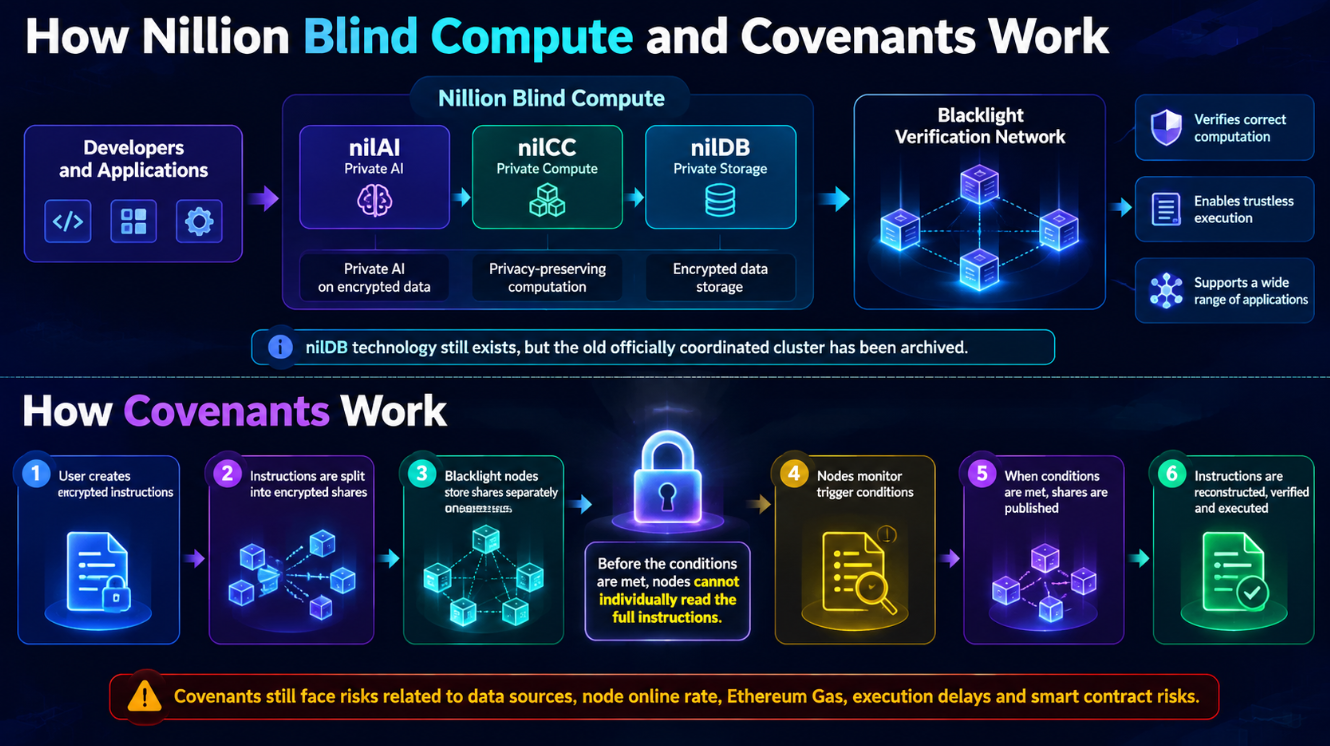
A Covenant can be understood as “an encrypted operating instruction that can only be opened after its conditions are met.” The basic process is as follows:
- A user creates an instruction with a trigger condition, such as executing an action after a price reaches a certain range.
- The instruction content is encrypted and split into multiple shares.
- Different Blacklight nodes each hold one share, and no single node can independently recover the complete instruction.
- Nodes continuously observe the data conditions bound to the instruction.
- Once the condition is met, nodes publish their shares on-chain.
- Once the threshold is reached, the instruction is reconstructed and verified before entering the subsequent execution process.
This structure aims to solve two problems: leaking strategy before conditions are triggered, and relying on a single centralized keeper to determine whether to execute.
But it also introduces new risks:
- Are the data sources accurate, timely, and difficult to manipulate?
- Will nodes go offline, delay submission, or collude?
- When Ethereum Gas rises, is triggering still economically viable?
- Is there latency between the trigger condition and downstream trade execution?
- Are there vulnerabilities in encrypted shares, registration contracts, or node software?
Therefore, the value of Covenants cannot be judged by design alone. What really needs to be verified is trigger success rate, average cost, latency, node uptime, and real paid request volume.
4. Is Anyone Actually Using Nillion? Historical Data and Current Data Must Be Separated
As of October 28, 2026, Nillion’s official developer page showed about 112,700 cumulative users, about 643.8 million historical documents, about 297.89 GB of historical storage data, and about 1.5 million AI inference calls. These figures at least show that the project is not entirely stuck at the whitepaper stage.
There are also specific applications in the ecosystem. For example, HealthBlocks uses privacy capabilities for health challenges and corporate activities. Nillion disclosed that more than 5,200 employees have participated in its challenges, and there have been cases of cooperation with enterprises and health brands.
However, the article cannot directly equate all cumulative data with current commercialization results.
Official documentation has clearly stated that the old nilDB cluster coordinated and operated by Nillion has stopped, and related data has been marked as a legacy cluster or archived. nilDB technology remains open source, and developers can build their own nodes or clusters, but historical document volume and storage volume cannot all be treated as current paid network demand.
Therefore, more valuable adoption metrics today should include:
- The number of active Blacklight L1 nodes.
- The actual amount of NIL staked on Ethereum L1.
- The number of Covenants created and successfully triggered.
- The scale of trigger fees and other network fees.
- Currently active applications rather than the cumulative number of announced partnerships.
- New call volume and payment status for nilAI and nilCC.
- Computing credits purchased with NIL and actually consumed.
The number of partners can prove market interest, but it cannot alone prove that the business model works. Only sustained usage, paid computing, and verifiable fees can support the long-term network economy.
5. What Is NIL Token Used For? Network Usage, Burning, Staking, and Governance
1. Paying for Privacy Computing and Resource Fees
In 2026, Nillion launched a unified developer entry point and changed some usage methods for nilDB, nilCC, and nilAI to a credit-based system. Official documentation states that developers can burn NIL to allocate computing credits to designated nodes.
This is one of the most important value-capture paths worth studying for NIL:
Developers use privacy services → buy or hold NIL → burn NIL for credits → NIL supply decreases or market demand increases.
However, to lower the barrier to use, nilAI also supports traditional payment entry points such as credit cards. Official explanations state that underlying computing still consumes resources paid for in NIL, but investors need to further verify the actual settlement path: whether traditional payments ultimately buy and burn NIL in the market, and whether the scale is large enough to matter.
2. Blacklight Node Staking
Blacklight L1 nodes help keep Covenants sealed before conditions are met and publish encrypted shares after conditions are satisfied.
The current official requirement is that an independent node stake at least 70,000 NIL. Nodes also need an always-online device, Docker, an Ethereum RPC, and roughly 0.01–0.015 ETH for registration and ongoing Gas payments.
70,000 NIL is a node operation threshold, not a fixed-yield product that every ordinary token holder can automatically access. Operators also bear:
- Node deployment and technical maintenance costs.
- Uptime and response requirements.
- Ethereum Gas volatility.
- Software failure and security risks.
- Waiting periods for staking, withdrawal, or migration.
3. Node Rewards and Trigger Fees
Blacklight L1 rewards come from roughly 0.5% annual token inflation and Covenant trigger fees. Inflation provides the base incentive, while trigger fees are closer to real network usage revenue.
From an investment perspective, the quality of the two is different:
- Inflation rewards are essentially paid by new supply and may create sell pressure.
- Trigger fees come from user demand and are a better proof that network economics are working.
The ideal state is that early on, inflation sustains node security, and later, as request volume increases, trigger fees account for a rising share of node revenue. If the network can only rely on inflation over the long term, it may lack the ability to sustain itself.
4. Governance and Network Participation
Nillion’s early NIL design includes governance use, allowing holders to participate in decisions around protocol parameters, upgrades, resource allocation, and community initiatives.
But governance rights are not equity in a company. Holding NIL does not mean owning shares in Nillion Labs or other related entities, nor does it automatically grant fixed dividends, profit sharing, or claims on project assets.
6. How Is Blacklight L1 Operating? 22% APR Cannot Be Simply Understood as Risk-Free Yield
As of October 28, 2026, Nillion’s official developer page showed about 24 million NIL staked and about 42 Blacklight nodes validating workloads; another official dashboard snapshot showed about 22.5 million staked and 41 active nodes. The difference of a few million tokens and one node may come from different update times.
The dashboard also shows a node APR of about 22.25%. This number is easy to misread.
Official base inflation is only about 0.5% per year, but rewards are shared by actual participating nodes and staked tokens. When the network-wide staking ratio is low, the annualized reward rate corresponding to a single eligible node may be significantly higher than total supply inflation; trigger fees may also increase node revenue.
Therefore:
- 0.5% is the base inflation parameter relative to overall supply.
- Node APR is a dynamic metric calculated relative to eligible staked capital.
- Node APR changes with staking volume, node count, fees, and network rules.
- Ordinary token holding does not automatically earn the APR shown on the dashboard.
- APR does not account for NIL price volatility, equipment, Gas, maintenance, and exit risks.
Based on roughly 24 million NIL staked and about 513 million NIL in circulation, NIL directly entering Blacklight node staking currently accounts for about 4.7% of circulating supply. This can create some lock-up demand, but it is not enough to prove that most circulating supply has left the market.
7. NIL Tokenomics: 1 Billion Is the Initial Supply, Not a Permanent Hard Cap
Nillion’s genesis token model announced in 2025 showed:
- Initial total supply of 1 billion tokens.
- Initial circulating ratio of 19.52%.
- Ecosystem and R&D accounted for 29%, or 290 million tokens.
- Community accounted for 20%, or 200 million tokens.
- Protocol development accounted for 10%, or 100 million tokens.
- Early supporters accounted for 21%, or 210 million tokens.
- Core contributors accounted for 20%, or 200 million tokens.
Early supporters and core contributors together account for 41%. The vesting, unlocking, and on-chain flows of these tokens may affect medium- and long-term supply.
Why We Can No Longer Say “Maximum Supply Is Fixed at 1 Billion”
1 billion is the genesis initial supply. Blacklight L1 has introduced roughly 0.5% annual inflation as the base node reward, so total supply will increase over time.
On October 28, 2026, platforms such as CoinGecko and CoinMarketCap showed total supply at about 1.011 billion tokens, with no fixed maximum supply set. This is not contradictory to “initial 1 billion”: the former reflects current supply after continued issuance, while the latter is the quantity at genesis.
This is also a common error that the article must correct:
Initial supply of 1 billion ≠ permanent maximum supply of 1 billion.
How Current Circulating Supply and FDV Should Be Calculated
Using the market snapshot on October 28, 2026 as an example, NIL’s price was about $0.084, circulating supply was about 513 million tokens, and total supply was about 1.011 billion tokens.
[ \text{Circulating market cap}=0.084\times513\text{ million}\approx$43\text{ million} ]
[ \text{FDV}=0.084\times1.011\text{ billion}\approx$84.8\text{ million} ]
The ratio of circulating market cap to FDV is about 51%. In other words, under the current statistical basis, about half of total supply is already counted as circulating, while the other half may still be affected by vesting, ecosystem allocation, node incentives, or other arrangements.
This is much higher than the initial circulating ratio of 19.52%, indicating that a large number of tokens have entered circulation over the past year or so. Researchers should not continue to describe the current market using TGE data.
Is 0.5% Inflation a Big Problem?
Looking at 0.5% alone, the inflation rate is not extreme. The real question is whether demand is growing.
If more developers burn NIL to buy credits, more nodes lock up NIL, and Covenants generate sustained trigger fees, new demand may offset inflation. If network requests are insufficient, nodes will continue to receive and sell rewards, and even a low 0.5% rate will add structural sell pressure.
8. Why Did NIL Migrate to Ethereum? What Happens to Old nilChain Assets?
Nillion’s official migration guide states that NIL migrated from the Cosmos-based nilChain to Ethereum ERC-20 as part of its shift to an Ethereum architecture. The team hopes to use Ethereum’s market, developer tools, settlement environment, and open participation mechanisms to coordinate staking, validation, and node operations.
Core Migration Information
- Old chain shutdown time: around March 23, 2026, at 13:00 UTC.
- Migration ratio: old NIL and new ERC-20 NIL are exchanged 1:1.
- Ticker: still NIL.
- New network: Ethereum.
- Official contract:
0x7Cf9a80db3B29eE8efE3710AadB7b95270572d47.
1:1 only indicates the token quantity exchange ratio. It does not mean the USD price is fixed, nor does it mean that same-name NIL tokens on all networks are interchangeable.
Can NIL on the Old nilChain Still Be Transferred?
The old nilChain has stopped running and can no longer be treated as a normal network for deposits and withdrawals. Old assets in personal wallets need to be handled according to Nillion’s official Merkle claim or migration process.
The official solution generates verifiable balance records based on the final chain state before shutdown. Users need to prove control with the original Cosmos private key and specify an Ethereum address to receive ERC-20 NIL.
If assets were originally held on an exchange, the handling method depends on the platform. Both Binance and Kraken have stated that they automatically completed the migration for users, and the old Cosmos network is no longer supported.
Mistakes Most Likely to Cause Losses
- Sending old nilChain NIL directly to an Ethereum address.
- Sending new ERC-20 NIL to an exchange’s old-network address.
- Connecting a wallet to fake migration websites found through search ads or direct messages.
- Checking only the name “NIL” without verifying the full contract address.
- Forcing a transfer before an exchange has enabled deposits on the new network.
9. Where to Buy Nillion? Current NIL Purchase Channels and Verification Process
NIL is already available for spot trading on multiple centralized trading markets. Public market pages as of October 28, 2026 show that major markets include Binance, Upbit, Bitget, Gate, Bitvavo, Kraken, and other platforms. Common trading pairs include NIL/USDT, NIL/TRY, NIL/KRW, and NIL/EUR.
Readers can also check NIL real-time quotes to view the price, trading volume, and market status displayed on the HIBT page.
However, the existence of a quote page does not mean trading is available in all regions. Before buying, you must confirm:
- The trading platform has enabled NIL spot trading, not just futures or a display page.
- The deposit and withdrawal network is labeled Ethereum ERC-20.
- The contract displayed by the platform matches the official address.
- The account’s region meets the platform’s access requirements.
- The trading pair has a real order book and sufficient depth.
Binance Migration Status
Binance announced on March 24, 2026 that it had completed ERC-20 integration for NIL and opened deposits and withdrawals for the Ethereum version; old mainnet NIL is no longer supported. Spot, margin, and futures trading were not entirely canceled during the migration.
Kraken Migration Status
Kraken stated that it had automatically converted user balances to Ethereum NIL at 1:1 and stopped supporting Cosmos NIL. Users do not need to manually migrate balances within the platform, but on-chain deposits must still use the correct network.
Upbit Market Changes
Upbit added a NIL/KRW market in October 2026, allowing Korean users to trade directly through NIL/KRW. The listing news triggered short-term significant price and volume volatility, showing that NIL remains highly sensitive to exchange events.
Differences Between Centralized Exchanges and On-Chain Swaps
Buying through a centralized exchange mainly involves risks from account security, platform custody, regional restrictions, and withdrawal status. Trading through on-chain pools mainly involves risks from incorrect contracts, approvals, Gas, slippage, and pool liquidity.
Regardless of the method used, the first withdrawal or on-chain purchase should use a small test amount.
10. How Is NIL Currently Performing? Behind High Volume: Spot Demand or Leveraged Speculation?
As of October 28, 2026, CoinGecko showed NIL at about $0.084, with a circulating market cap of about $43 million, FDV of about $84.8 million, and 24-hour trading volume of about $57.4 million. CoinMarketCap gave a higher trading volume for the same period, indicating differences in market inclusion and statistical methodology across platforms.
More noteworthy is that CoinGecko showed NIL’s 24-hour perpetual futures trading volume at about 21.6 times its spot volume, and open interest even higher than circulating market cap.
This means:
- Prices may be significantly affected by highly leveraged long and short trading.
- High trading volume does not necessarily mean large spot funds are holding long term.
- Liquidations and funding rate changes may amplify short-term moves.
- Listing announcements may trigger short-term rallies followed by rapid pullbacks.
When the Upbit KRW market launched on October 27, NIL briefly rose within minutes on other markets and then visibly gave back gains. This is typical event-driven price discovery and cannot be directly interpreted as network fundamentals improving by the same magnitude within minutes.
Investors should also check:
- Spot trading volume versus perpetual futures trading volume.
- Order book depth within ±2% on major markets.
- Bid-ask spread.
- Funding rates and open interest.
- Large addresses depositing to exchanges.
- Changes in circulating supply and node staking volume.
High volume only proves active trading; it does not prove long-term value.
11. Is NIL Worth Buying? It Must Pass Three Validation Gates
My judgment is: Nillion’s technology and product direction are worth continued research, but NIL is currently still a high-risk, narrative-driven infrastructure token that needs to prove real demand.
Before raising my long-term investment assessment, I would require it to pass three gates.
Gate One: Privacy Computing Must Generate Real Paid Demand
We need to see sustained growth in currently active applications, computing requests, AI inference, Covenant triggers, and paid credits—not just cumulative historical data or partnership announcements.
In particular, distinguish between:
- Historical old nilDB data and current active usage.
- Testnet calls and mainnet paid calls.
- Announced integrations and integrations that continuously generate fees.
- Free incentivized users and real paying customers.
Gate Two: Network Growth Must Translate Into NIL Demand
We need to confirm that developers using resources will burn or buy NIL, that Blacklight nodes need to continuously stake NIL, and that trigger fees grow with network usage.
If users can use the product heavily without creating any public-market NIL demand, project growth will be hard-pressed to support token valuation.
Gate Three: New Demand Must Cover Supply and Liquidity Risks
NIL still has vesting supply, ecosystem allocation, and node inflation. Actual demand must be able to absorb new tokens, while spot depth should gradually improve and perpetual futures speculation should not remain far above spot usage for a long time.
None of the three gates can be omitted. Advanced technology with no one paying does not constitute long-term value; usage without NIL demand does not constitute complete value capture; and token demand with excessive valuation or greater supply pressure may still not be a good price.
12. NIL Bull Case: What Would Strengthen the Long-Term Thesis
Encrypted Markets Achieves Real Adoption
If trading protocols, vaults, AI agents, and prediction markets begin using Covenants to hide conditions and continuously pay trigger fees, Nillion will have clear commercial demand.
The Blacklight Node Network Continues to Expand
More independent nodes, more staking, and better geographic distribution can improve network security. A rising share of trigger fees in node revenue would also reduce reliance on inflation.
NIL Burning and Resource Usage Grow
Developers burning NIL to buy credits is relatively direct value capture. If burn volume grows in sync with computing demand, it can partially offset inflation and unlock supply.
The Ethereum Ecosystem Brings More Integrations
After migrating to Ethereum, NIL can more easily enter existing wallets, exchanges, DeFi, and developer tools. If this convenience translates into real applications rather than just more trading channels, the long-term thesis would improve.
Privacy AI Becomes a Necessity
Enterprises and individuals are paying more attention to the privacy of model inputs, health, identity, and commercial data. If Nillion can provide developer-friendly private AI at acceptable cost, its product demand may experience structural growth.
13. What Signals Would Invalidate the NIL Bull Case?
1. Current Active Usage Does Not Grow Over the Long Term
If the official team can only continue to show cumulative historical metrics and cannot provide new calls, paid requests, and currently active projects, commercial adoption may be lower than the narrative suggests.
2. The Covenants Roadmap Is Delayed or Lacks Real Applications
If later phases are repeatedly delayed, or if mainnet only has demonstrations without sustained trigger requests, the valuation logic for Encrypted Markets would weaken.
3. Token Consumption Diverges From Network Usage
If application growth does not bring NIL burning, fees, or staking demand, NIL cannot effectively capture network value.
4. Node Revenue Remains Dependent on Inflation for a Long Time
If trigger fees are insufficient and nodes mainly rely on new token issuance for revenue, network security costs may continue to translate into market sell pressure.
5. Nodes Become Overly Concentrated
The current number of active nodes is still limited. If staking and validation power are concentrated among a few operators, decentralization and anti-collusion capabilities need further verification.
6. Supply Growth Outpaces Spot Demand
If vesting tokens, node rewards, and ecosystem funds enter the market while spot buying and depth do not improve in tandem, valuation may be pressured lower.
7. Perpetual Futures Dominate Price Discovery
If derivatives trading volume remains far above spot for a long time, NIL may continue to exhibit high volatility, event-driven behavior, and liquidation-driven characteristics.
8. Privacy and Regulatory Risks
Privacy technology may face scrutiny in different jurisdictions. Even if Nillion mainly provides infrastructure, application scenarios and trading functions may still face compliance restrictions.
14. How Should NIL Price Predictions Be Viewed?
You can refer to NIL price prediction, but prediction pages can only reflect a specific model or market expectation and cannot replace network data and supply analysis.
For a token that has gone through a chain migration, product pivot, and node economics adjustment, directly predicting an exact price for 2030 has limited meaning. A more reasonable approach is to use three scenarios.
Bull Scenario
Covenants and Encrypted Markets gain real usage, developers continue to burn NIL, Blacklight node count and staking grow, trigger fees gradually replace part of inflation incentives, and spot depth improves.
In this case, the market may re-evaluate NIL’s value as privacy computing infrastructure.
Base Scenario
Technology and roadmap continue to progress, but paid usage grows slowly; the node network relies on base inflation, and token demand can absorb part of supply but does not form strong net demand.
NIL may continue to trade mainly in a range driven by events, listings, and market cycles.
Bear Scenario
Current application usage is insufficient, the roadmap is delayed, node fee revenue remains low, supply continues to increase, and market liquidity weakens.
Even if privacy computing remains a promising industry, NIL’s valuation may continue to face pressure.
When Valuation Needs to Be Recalculated
- Active Covenant requests show sustained growth.
- NIL burn volume and trigger fees have verifiable data.
- Blacklight nodes and staking structure improve significantly.
- Unlocks, inflation, or circulating supply change materially.
- The structure of perpetual futures versus spot trading volume changes.
15. What Is the Difference Between NIL and AXIS?
Investors can further read What Is AXIS Token, but they cannot use the same valuation method just because both are related to new technology or AI.
NIL’s core is privacy computing, private AI, Encrypted Markets, node validation, and resource payments. Key metrics to watch are computing requests, NIL burning, node staking, trigger fees, and roadmap execution.
If AXIS is positioned around Physical AI or robotics data infrastructure, then key metrics should include real devices, training data, enterprise customers, data contributors, and the token’s role in the physical network.
Both may receive an AI narrative premium, but their sources of value are completely different. Similar themes do not mean similar risks, and they certainly do not mean you can directly compare which one is cheaper based on unit price.
16. Why Do BTC and ETH Trends Still Affect NIL?
NIL’s long-term fundamentals come from the Nillion network, but its short-term price still sits within the crypto market funding system.
Investors can use BTC price prediction to judge overall market risk appetite, and can also refer to ETH price prediction to observe the valuation environment for Ethereum, DeFi, and infrastructure tokens.
When BTC falls rapidly, capital usually reduces exposure to small-cap, high-volatility assets first. Weakness in ETH may also reduce the market’s risk appetite for Ethereum ecosystem projects.
But it must be clear:
- A BTC rally does not automatically increase Nillion computing requests.
- An ETH rally does not automatically generate Covenant trigger fees.
- Broad market trends cannot prove that NIL is undervalued.
- A bullish broad market also cannot eliminate supply, node, and product adoption risks.
17. If You Decide to Buy NIL, What Strategy Should You Use?
Step One: Confirm You Are Buying New ERC-20 NIL
Copy the full contract address from Nillion’s official migration page and verify the trading platform network. Do not copy contracts from social media comments, direct messages, or links in search ads.
Step Two: Separate Trading From Long-Term Investing
If the reason for buying is the Upbit listing, increased volume, or a short-term breakout, the position should be managed as event trading. If the reason for buying is long-term privacy computing, then product, fees, and token demand must be tracked continuously.
Do not retroactively rename a trade as a long-term investment after a short-term decline.
Step Three: Do Not Judge Cheapness by Unit Price
$0.08 does not mean a token is cheaper than one trading at $8. You should look at circulating supply, circulating market cap, FDV, inflation, unlocks, and market depth at the same time.
Step Four: Separate Ordinary Holding From Running a Node
Ordinary token holders bear price risk; running a Blacklight node also involves 70,000 NIL staking, ETH Gas, equipment, uptime, software, and technical maintenance risks. Do not treat node APR as a risk-free yield that ordinary users can directly earn.
Step Five: Use Staged Position Sizing
Risk budget can be divided into an observation position, a fundamentals-confirmation position, and a trend position. Only increase position size when real usage, NIL demand, and market structure improve together.
Step Six: Set Exit Conditions in Advance
The following can be treated as re-evaluation signals:
- Current active usage shows no growth over the long term.
- NIL burn and fee data are weaker than expected.
- Node count or staking declines significantly.
- The roadmap is repeatedly delayed.
- Circulating supply rises while spot depth falls.
- Price is mainly driven by highly leveraged contracts.
18. Ten Nillion Metrics I Will Track Long Term
- Number of active Blacklight L1 nodes.
- Total NIL staked and its share of circulating supply.
- Number of Covenants created and successfully triggered.
- Scale of trigger fees earned by nodes.
- NIL burn volume and developer credit purchases.
- Current paid call volume for nilAI and nilCC.
- Currently active applications and repeat usage rate.
- NIL circulating supply, vesting releases, and node inflation.
- Spot depth, spreads, and derivatives share of trading volume.
- Whether network fee revenue can gradually cover node security costs.
These ten metrics can be compressed into one judgment model:
Real privacy demand × NIL value capture × node security × supply discipline ÷ current valuation.
19. Common Questions About Nillion and NIL
What Is Nillion Token?
NIL is the native token of the Nillion network, used for network resources, privacy computing services, node staking, validation incentives, governance, and other scenarios.
What Is Nillion’s Blind Compute?
Blind Compute is a technology and product system that completes storage, AI inference, or other computations while minimizing exposure of raw sensitive data to application backends and infrastructure operators.
What Is Encrypted Markets?
Encrypted Markets is Nillion’s new product direction, aiming to use mechanisms such as Covenants to keep trading or execution instructions encrypted until conditions are met.
Where to Buy Nillion
Public market pages show that Binance, Upbit, Bitget, Gate, Bitvavo, Kraken, and other platforms support NIL markets. Actual trading pairs, regional access, and deposit/withdrawal status should be verified on the day of purchase.
What Is NIL’s Official Ethereum Contract Address?
The official address is 0x7Cf9a80db3B29eE8efE3710AadB7b95270572d47.
Why Did NIL Migrate to Ethereum?
Nillion hopes to use Ethereum’s market, developer tools, settlement environment, and open node participation mechanisms to support future staking, validation, and Encrypted Markets.
Can NIL on the Old nilChain Still Be Transferred Normally?
It can no longer be treated as a normally running network. The old nilChain has stopped, and personal wallet assets need to be converted to ERC-20 NIL according to the official migration and claim process.
What Is NIL’s Total Supply?
The genesis initial supply was 1 billion tokens. Because Blacklight nodes have roughly 0.5% annual inflation rewards, current total supply is already above 1 billion and is not permanently fixed at 1 billion.
What Is NIL Staking Yield?
Yield changes with participating stake, node count, inflation, trigger fees, and network parameters. The node APR shown on the official dashboard is not a fixed yield for ordinary token holders.
How Much NIL Is Needed to Run a Blacklight Node?
An independent Blacklight L1 node currently needs to stake at least 70,000 NIL and also needs ETH for registration and ongoing Gas.
Is NIL Worth Buying?
Nillion’s technology is worth studying, but NIL still needs to prove that real network usage can create sustained token demand and is sufficient to cover inflation, unlocks, and market risks.
Is NIL Suitable for Long-Term Holding?
It is more suitable for high-risk investors who can continuously track privacy computing adoption, node economics, and supply changes. It is not suitable for passive long-term holding based only on AI or privacy narratives.
What Should NIL Price Predictions Focus On?
They should simultaneously observe computing requests, token burning, node staking, trigger fees, circulating supply, FDV, spot depth, and the overall market cycle.
What Is the Difference Between NIL and AXIS?
NIL mainly targets privacy computing and encrypted market infrastructure; AXIS is more focused on Physical AI or related data infrastructure. Their customers, use cases, and value capture mechanisms are different.
20. Final Conclusion: Nillion Is Worth Researching, but NIL Still Needs to Prove a Closed-Loop Network Economy
Nillion is not just a concept project with an “AI + privacy” label. It has already launched developer tools, privacy computing modules, and the Blacklight node network, and has advanced its product mainline to Encrypted Markets. NIL also has clearer uses than ordinary narrative tokens: resource payment and burning, node staking, validation rewards, and governance.
But the real investment challenge is not whether the use cases can be written into documentation, but whether those use cases generate demand at scale.
Nillion is currently undergoing both a product pivot and a network migration. The old nilChain has stopped, and NIL has migrated to Ethereum; the old coordinated nilDB cluster has also been archived, and cumulative historical data cannot directly represent current commercial demand. Although Blacklight L1 already has active nodes and staking, it still needs to prove that Covenants can generate enough trigger fees for node economics to gradually reduce reliance on inflation.
Therefore, my conclusion is:
Nillion is worth continued research, but NIL should currently be viewed as a high-risk early-stage privacy computing infrastructure token, not a validated long-term blue chip.
Raising the long-term assessment requires three pieces of evidence: current active applications and paid computing continue to grow, network usage can translate into NIL burning and staking demand, and that demand is sufficient to absorb vesting releases and node inflation.
If these three pieces of evidence gradually materialize, NIL’s long-term thesis would strengthen significantly. If we can only see technical roadmaps, cumulative historical data, and exchange hype without sustained fees and token consumption, then even if the privacy computing industry has broad prospects, that would not be enough to justify a long-term heavy position in NIL.
First confirm that you are buying the correct migrated ERC-20 NIL, then verify whether the network truly generates demand, and only then discuss price. The order cannot be reversed.
Main Sources
- Nillion: NIL Token Migration Guide
- Nillion: Blacklight Node Migration to Ethereum L1
- Nillion: The Road to Encrypted Markets
- Nillion: Official Roadmap
- Nillion Developer: Network and Node Data
- Nillion Docs: Blind Computer
- Nillion: NIL Tokenomics
- Binance: NIL ERC-20 Integration Announcement
- Kraken: NIL Migration Notice
- CoinGecko: Nillion Market Data
Risk Disclaimer: This article is for information and research only and does not constitute investment advice, a promise of returns, or a recommendation to purchase. Crypto assets may experience severe volatility and lose all principal. Before trading, independently verify contracts, networks, platform status, and local regulations.